The Nigerian chemist working at the frontier of biosensors, nanotechnology and environmental science, and what her career reveals about the scientific network Nigeria has yet to fully build.

Demilade Fate
Demilade Fate
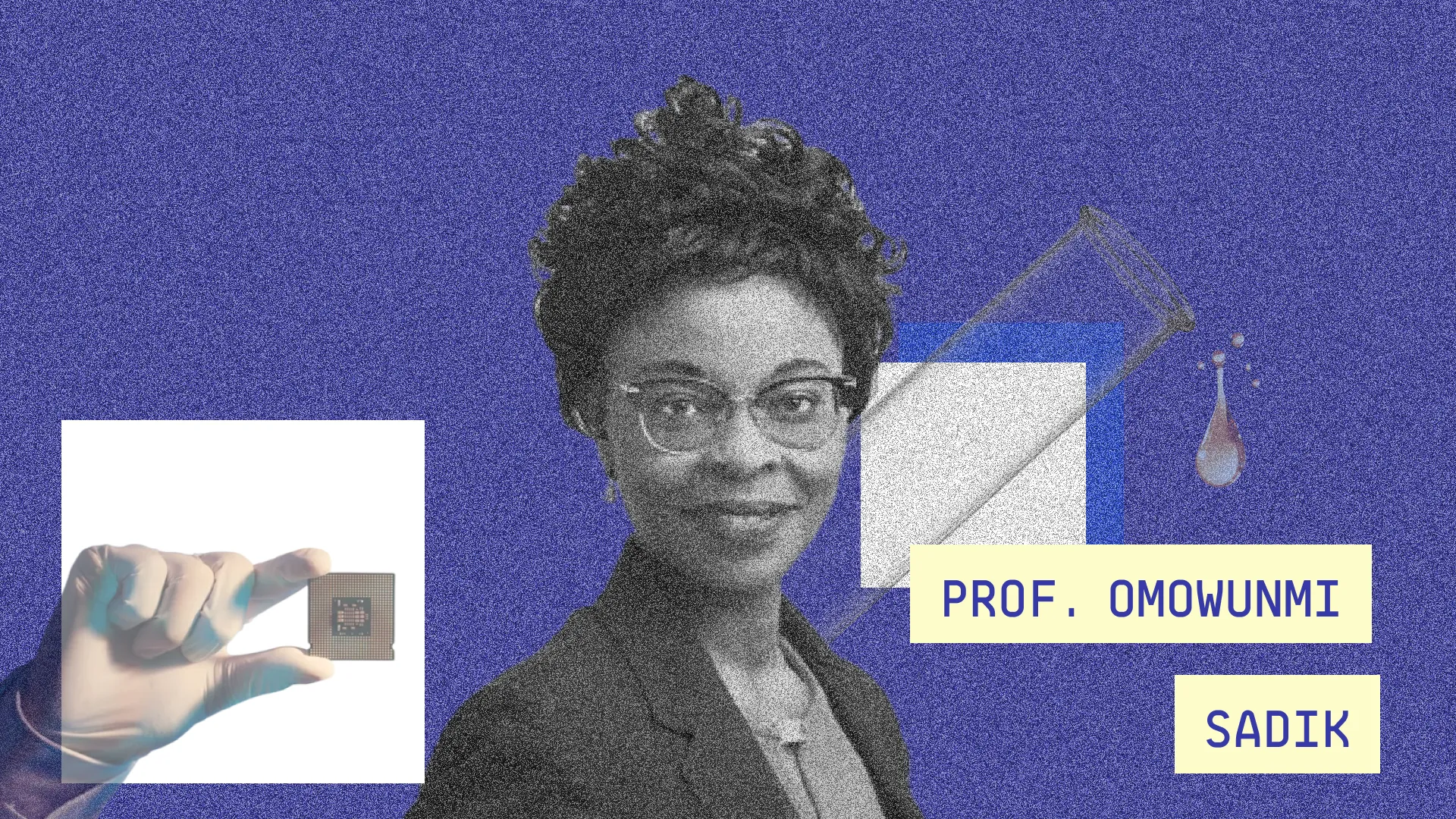
Today, I introduce you to a peculiar kind of scientific invisibility.
What makes it peculiar is that it doesn’t describe the invisibility of an unknown scientist, but that of an already recognised one. A scientist can be quite visible to the people who work in her field, publishing papers that are read, cited and debated around the world, while remaining almost completely absent from the intellectual landscape of the country from which she came.
Professor Omowunmi A. Sadik is my interesting test case for this idea.
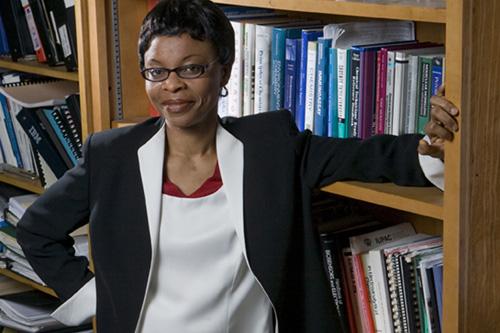
Born in Lagos in 1964, Sadik studied chemistry at the University of Lagos before leaving Nigeria for doctoral study at the University of Wollongong in Australia. She subsequently worked at the United States Environmental Protection Agency and built a career in the United States in chemistry, environmental science and nanotechnology. She is now a Distinguished Professor of Chemistry and Environmental Science at the New Jersey Institute of Technology, where her research encompasses biosensors, surface chemistry, electrochemistry and nanostructured conducting polymers.[1]
She has also accumulated the sort of international scientific record that makes her biography considerably more than a conventional story about a successful Nigerian academic abroad. She has held appointments or collaborations involving institutions such as Harvard, Cornell and the U.S. Naval Research Laboratory; she has been recognised by major scientific organisations; she has helped establish scientific institutions and organisations; and in 2016 Nigeria awarded her the Nigerian National Order of Merit, the country’s highest academic distinction.[2, 3, 13]
But what’s of the most interest to me about Sadik today goes beyond her CV. It is this question: What could happen if a country, Nigeria to be specific, were deeply connected to scientists like Omowunmi Sadik, not merely proud of them?
Before we get to that, however…
The phrase “biosensor” can sound like something from the distant future. In reality, the underlying idea is remarkably simple.
A sensor is a device that detects something. A thermometer detects temperature. A microphone detects sound. A smoke detector detects particular chemical products of combustion. A chemical or biological sensor does something analogous at a much smaller scale: it is designed to recognise a particular chemical or biological substance and translate that recognition into a measurable signal.[4]
The difficulty is making the sensor sensitive enough, selective enough, reliable enough, cheap enough and portable enough to be useful outside an ideal laboratory.
It is here that Sadik’s research acquires its relevance.
Her work has investigated electrochemical and optical biosensors, conducting polymers, nanostructured materials and molecular recognition. Some of her research has been aimed at creating devices capable of detecting substances at very low concentrations and making environmental analysis more portable and practical.[5]
To illustrate the scale and extent of it: at the U.S. Environmental Protection Agency and subsequently in her academic research, Sadik worked on sensor systems for environmental monitoring. One of the systems described in the scientific literature combined a biosensor with automated sampling and was designed to operate in the field rather than requiring every sample to be brought back to a conventional laboratory. The prototype was battery-powered and designed to minimise user intervention.[5]
The importance of this detail is hard to overstate. Traditional environmental chemistry can require taking samples of air, water or soil and transporting them to laboratories containing expensive instruments and highly trained personnel. This becomes difficult when there are hundreds or thousands of samples, when contamination needs to be monitored over time, or when the place being investigated is itself hazardous or remote.
A sufficiently capable portable sensor changes the problem. So instead of getting stuck with the question of how to bring the sample to the laboratory, the question becomes, “How do we bring the laboratory’s analytical capability to the sample?” And that takes us beyond the mere chemistry of the matter.
Some of Sadik’s work has concerned the detection of environmental contaminants and the chemistry of toxic substances.
One line of research investigated the conversion of hexavalent chromium, Cr(VI), into trivalent chromium, Cr(III). The distinction is chemically important because Cr(VI) is considerably more toxic than Cr(III).[6]
In work associated with Sadik’s research group, nanomaterials were investigated as catalysts for accelerating this transformation. A published environmental-chemistry account described experiments in which palladium nanoparticles substantially accelerated the conversion of Cr(VI) to Cr(III), including experiments using contaminated soil.[5]
Here, we have a situation where you have a dangerous chemical form. You don’t necessarily need to make the element disappear. You can change its chemical state. The challenge, of course, is turning an interesting laboratory reaction into a practical environmental technology. That requires much more than demonstrating that a chemical transformation works. It requires questions about cost, scale, material recovery, secondary environmental effects, engineering, field conditions, monitoring, regulation and deployment. And this is rather important.
After all, it is not uncommon for scientific journalism to jump directly from “scientists have demonstrated X” to “this could solve Africa’s problem Y.” The reality of science is naturally more complicated, and also more interesting, than that. The space between a laboratory result and a technology operating in the world is a vast scientific and engineering territory.
Because Nigeria is not an abstract place on a map to which environmental chemistry has to be imported as a foreign concern. Nigeria has enormous environmental and industrial systems whose monitoring and management require chemistry.
Oil production creates complex environmental problems. Mining introduces questions involving metals and contaminated soils and water. Industrialisation produces chemical wastes. Agriculture introduces pesticides and fertilisers. Urbanisation creates enormous waste streams. Water quality requires continuous monitoring.[7, 8]
Yet I’m not about to ask a rather simplistic question like “Can Omowunmi Sadik’s research solve Nigeria’s environmental problems?” There’s a much better framing than that: Could Nigerian scientists, engineers, industries and public institutions make use of the scientific capabilities represented by this kind of research?
Suppose a Nigerian environmental laboratory had access to a network of researchers working on advanced chemical sensors. Suppose a Nigerian materials scientist could collaborate directly with a group developing nanostructured sensing materials. Suppose a university laboratory working on heavy-metal contamination could exchange samples, methods and students with Sadik’s research group. Suppose environmental agencies could communicate directly with scientists capable of designing sensors for particular Nigerian monitoring problems. And suppose Nigerian manufacturers eventually had access to the expertise necessary to turn laboratory prototypes into locally manufactured analytical instruments.
None of these things follows automatically from having a Nigerian scientist who works on biosensors. But none of them can happen easily if the scientist and the country exist in largely separate scientific worlds. And that deeper problem is what this is about.
It would be inaccurate to portray Sadik as simply “unknown in Nigeria.” Nigeria knows who she is.
As I mentioned at the beginning, the Nigerian National Merit Award’s official record identifies her as a 2016 laureate in science. It records her University of Lagos education, her PhD from Wollongong and her work on microelectrode biosensors and environmental applications.[1]
The University of Wollongong has also highlighted her achievements, describing her research as focused on interfaces and bioanalytical sensing technologies for human health and the environment, and noting her international scientific leadership and work in sustainable nanotechnology.[3]
Nigerian newspapers have reported on her achievements as well.[9] She has not, in other words, disappeared completely from Nigerian public consciousness. But that’s not what really matters, is it?
Recognition is not the same thing as scientific integration.
Recognition is not the same thing as scientific integration. A scientist can receive a national honour, appear in newspapers and be celebrated as a distinguished Nigerian while the details of her scientific work remain largely unknown outside a relatively small circle of specialists. That distinction is important for this column’s larger purpose.
I am not suggesting that Omowunmi Sadik is disconnected from the Nigerian research ecosystem. She plainly is not. There are already links, collaborations and professional relationships, and it would be both inaccurate and unfair to suggest otherwise.
The question is one of optimality and adequacy. How dense are those connections? How numerous are they? How much of her expertise circulates through Nigerian scientific institutions? How many researchers working in adjacent fields know her work well? How many students encounter it? How many Nigerian laboratories have interacted with her laboratory? How many opportunities for collaboration exist that have never become collaborations? And, most importantly, how close is the Nigerian scientific system to making the fullest productive use of the connections it already possesses?
Those are important empirical questions.
Indeed, I would very much hope that we could pursue them through reporting: by speaking with Sadik herself, and with at least two to four Nigerian researchers working in adjacent fields, especially Professor Wesley Okiei, whose research at the University of Lagos includes electrochemical analysis, nanosensors and environmental contaminants and who has worked with Sadik.
Such conversations could tell us something an essay alone cannot. They could reveal what collaborations already exist, what has worked, what has failed, what opportunities have been missed, what Nigerian researchers actually need from the diaspora, what diaspora scientists need from Nigerian institutions, and whether the apparent gaps are as large, or as simple, as they might seem from the outside.
In other words, the question “How connected is Omowunmi Sadik to Nigerian science?” should ultimately become a reported question rather than merely an essayistic one. And that is exactly the sort of question this column exists to pursue.
This distinction deserves emphasis.
To reiterate, a country can honour a scientist without having a dense scientific relationship with that scientist. It can give her an award. It can publish a newspaper profile. It can celebrate her as evidence that Nigerians can succeed internationally. But a functioning scientific system requires something more.
It requires connections. Who cites her work? Who collaborates with her? Who sends students to her laboratory? Who invites her to Nigerian research meetings? Who discusses her research in Nigerian laboratories? Who is working on adjacent problems? Who has access to the instruments and techniques that she has developed? Who is trying to solve Nigerian environmental problems using related technologies? Which Nigerian researchers could benefit from her experience? And what could she gain from the researchers working in Nigeria?
These are questions about infrastructure, not personalities per se.
One particularly valuable piece of evidence is the University of Lagos.
Professor Wesley Okiei’s research profile (I mentioned him just now) lists Sadik among his international collaborators. His group’s work includes electrochemical sensors and nanomaterial applications, including research on lead and cadmium in Nigerian soils and chitosan-based nanosensors.[10]
That is exactly the sort of connection we’re interested in. It is an actual connection between a Nigerian university research group and a Nigerian-born scientist whose research lies in overlapping territory.
The goal is not to claim that Nigeria has no scientific connections to its diaspora. The question is whether there are enough of them.
Are they systematic or accidental? Are they concentrated in a handful of individuals? Can they survive changes in personnel? Do they involve students? Do they produce joint publications? Do they produce instruments, patents, companies or field projects? Do they connect universities to industry and government? And how many similar relationships exist that nobody outside the participants knows about?
We will be asking and exploring more of these questions in subsequent articles, across a wider variety of fields and researchers.
Imagine, for a moment, that you could draw every Nigerian researcher working on environmental sensing, nanomaterials, electrochemistry, toxicology, water quality and environmental remediation.
Then add Nigerians in the diaspora working on the same problems. Then add researchers elsewhere in Africa. Then add environmental agencies. Then add industrial laboratories. Then add manufacturers capable of producing instruments. And then add venture capital, government research funding and universities.
What would you see?
You might discover that the problem is not a complete absence of expertise. You might discover islands of expertise. One laboratory has electrochemistry. Another has nanomaterials. Another has environmental toxicology. Another has agricultural applications. Another has access to contaminated field sites. Another has engineering expertise. Another has industry connections. Another has a researcher abroad with access to equipment unavailable locally.
The pieces exist. But the pieces may not form a system or feedback loop. This is one of the great hidden problems of scientific development. And it is one silently afflicting Nigeria.
A country does not become a scientific power simply by accumulating brilliant individuals. It becomes one when its individuals begin to function as a system.
Making researchers like Sadik subjects of discussion in this kind of media context is meant to facilitate such connections. Students should become aware of her work. Scientists should become aware of her work. The visibility and interaction with the content of her research should become commensurate with the level of its national importance. It should become “a thing.” And this isn’t limited to her alone. It applies just as much to every Nigerian scientist, home and abroad, obscure or recognised, doing important niche work that doesn’t get the attention or circulation it deserves.
There is an old way of thinking about the African scientific diaspora. The story is usually framed as loss. A talent or scientist leaves. The country, the laboratory, the university, loses the scientist. The diaspora then becomes a symbol of brain drain.
There is a kernel of truth in that.[11] But it is incomplete, is it not?
Consider what happens when a scientist spends decades in a major international research environment. She acquires not merely knowledge. She acquires networks. She learns how major laboratories operate. She encounters research cultures. She works with students and collaborators from different countries, learns how grants are assembled, encounters new instrumentation, and participates in professional societies.
She becomes familiar with the people deciding where fields are going. She builds a reputation that gives her access to other institutions and accumulates knowledge about how scientific systems themselves work.
The diaspora therefore contains something more valuable for what we’re trying to achieve vis-à-vis scientific visibility, integration, and circulation of important scientific work in the appropriate quarters. It contains nodes in an international network.
And Sadik’s career illustrates this unusually well. She became a leader in sustainable nanotechnology and co-founded the Sustainable Nanotechnology Organization, an international professional society concerned with responsible nanotechnology. She has also occupied leadership and professional positions in scientific organisations.[12, 13]
If Nigeria is connected to her, it isn’t merely connected to one chemist. It is potentially connected to part of a global scientific network. And this is what makes connections between our scientists even more paramount. The longer it is delayed, the longer opportunities to benefit locally from our scientists’ presence in the global scientific scene will get wasted.
We see then where the conversation about the diaspora often goes wrong.
Someone might ask what they see as the obvious question: Why doesn’t she return to Nigeria? But that naively assumes physical relocation is the only meaningful form of scientific connection. It obviously isn’t. A scientist does not have to live in Lagos to contribute to Nigerian science or for Nigeria to benefit from her scientific stature.
She could co-supervise Nigerian doctoral students. She could collaborate with laboratories in Lagos, Ibadan, Ile-Ife, Zaria or Nsukka, help establish a sensor-development programme, advise on laboratory design, connect Nigerian researchers to international collaborators, help Nigerian students enter international research networks, or participate in joint projects addressing Nigerian environmental problems.
She could help build intellectual bridges between Nigerian institutions and the global scientific community. And Nigerian scientists could contribute something to her research too: field problems, local expertise, samples, biological systems, environmental data, experimental contexts and scientific questions that are difficult to reproduce elsewhere.
So we don’t even need to imagine the relationship as Nigeria receiving knowledge from a successful diaspora scientist. We should imagine it as two scientific systems exchanging capabilities in a way that optimises the country’s scientific productivity.
She is a kind of test case.
Her career allows us to ask what Nigerian science might look like if the boundaries between domestic science and diaspora science became much more permeable. What if Nigerian universities systematically mapped their diaspora researchers and every major research field maintained a directory of Nigerian scientists around the world?
Imagine if a Nigerian doctoral student could search for Nigerian researchers abroad working on precisely the problem she was investigating? Or if laboratories actively sought diaspora collaborators not merely for ceremonial lectures but for experiments?
Think of the benefits if scientific societies imbibed the culture of organising their conferences around research problems more often than simply around institutions.
If the next generation of Nigerian researchers grew up knowing not just that “there are Nigerians doing science abroad,” but who they are, what they study, where they work and how their work connects to problems at home, the difference would be enormous.
There is another potential danger in these diaspora conversations: treating the scientist abroad as the repository of advanced knowledge and the scientist at home as the person waiting to receive it. That is, quite frankly, wrong.
Nigeria has researchers doing serious work of their own. Professor Wesley Okiei’s group at the University of Lagos, for example, works on electrochemical analysis, nanosensors and environmental contaminants, including lead and cadmium in Nigerian soils. His profile explicitly lists Sadik among his international collaborators.[10]
That is not simply an example of a Nigerian scientist “benefiting” from an overseas expert. It is potentially a two-way scientific relationship.
A Nigerian laboratory has something important that a laboratory in New Jersey does not possess in the same way: Nigeria itself. Its soils. Its water. Its agricultural systems. Its industrial environments. Its biological diversity, pollution problems, and particular combinations of environmental and economic conditions. These are scientific assets.
The right international relationship would allow Nigerian researchers to turn local problems into research questions of global significance while allowing international collaborators to contribute tools, methods and expertise.
That is the kind of scientific network we envision.
We have become accustomed to stories about African scientists that follow a predictable pattern.
They were born in Africa, they overcame adversity, they went abroad, became successful, made Africa proud. Such stories are beautiful and definitely have their place. But they can accidentally reinforce the very isolation they celebrate, and we may never get anything out of them beyond their sensational and national esteem value.
The scientist becomes an exceptional individual. The foreign university becomes the place where serious science happens. Africa becomes the place the scientist came from. And the story ends with applause.
A more useful story asks the following additional questions: What did she discover? Who is building on it? Who else is working on it? Where are the laboratories? What equipment is required? What problems could the research address? Which African researchers are adjacent to it? Which industries could use it? Which government agencies need it? Which students could be trained in it? What would it take to move the science from paper to prototype to product?
And a question very central to our concerns: Why don’t more of these people know one another?
It is not merely about telling Africans that African scientists exist. We need to make African science legible to itself.
Omowunmi Sadik was born in Lagos and studied chemistry at the University of Lagos. She then went abroad, became an internationally recognised scientist, and Nigeria eventually gave her one of its highest academic honours.
Her research now sits at the intersection of chemistry, sensors, nanotechnology, environmental science and sustainability. And somewhere in Nigeria, there are researchers whose own work touches parts of that same intellectual territory.
At least some of those connections already exist. The question is how many more could exist.
How many Omowunmi Sadiks has Nigeria produced? Sure, that’s an interesting question. How many Nigerian scientists have left? That is an interesting question too. But “How many Nigerian scientists are working on related problems without knowing one another?” is an even more interesting question. And even more interesting is asking what Nigerian science could become if those people could see one another.
A country does not become a scientific power simply by accumulating brilliant individuals. It becomes one when its individuals begin to function as a system.
Discoveries travel from laboratory to laboratory, students moving between research groups, engineers finding chemists, mathematicians finding physicists, universities finding industries, and government agencies finding researchers.
We need researchers abroad to remain intellectually connected to researchers at home.
Omowunmi Sadik is not only a researcher who needs to be better known, even though I believe she should be. Here, she serves as an invitation to a larger question: What if the scientists of Africa could finally become conspicuous to one another?
Perhaps the first technology we need is a science journalism that facilitates this.
[1] Nigerian National Merit Award. “Professor Omowunmi A. Sadik.” https://www.nnma.gov.ng/laureate-detail.php?laureate=NNMA73
[2] University of Wollongong. “Leadership talent shines at UOW Alumni Awards.” 2023. https://www.uow.edu.au/media/2023/leadership-talent-shines-at-uow-alumni-awards-.php
[3] University of Wollongong, The Stand. “Perfect chemistry.” 2023. https://www.uow.edu.au/the-stand/2023/perfect-chemistry-.php
[4] International Union of Pure and Applied Chemistry. “Biosensor.” Compendium of Chemical Terminology, Gold Book. https://goldbook.iupac.org/terms/view/B00663
[5] Sadik, O. A., Wanekaya, A. K., and Andreescu, S. “Advances in analytical technologies for environmental protection and public safety.” Journal of Environmental Monitoring, 2004. https://doi.org/10.1039/b401794n
[6] Agency for Toxic Substances and Disease Registry. “Toxicological Profile for Chromium.” https://www.atsdr.cdc.gov/toxprofiles/tp7.pdf
[7] United Nations Environment Programme. “Environmental Assessment of Ogoniland.” https://www.unep.org/resources/report/environmental-assessment-ogoniland
[8] World Bank. “A Wake Up Call: Nigeria Water Supply, Sanitation, and Hygiene Poverty Diagnostic.” 2017. https://openknowledge.worldbank.org/handle/10986/27703
[9] Vanguard News. “Meet Nigerian scholar Omowunmi Sadik who invented explosive detection device in US.” https://www.vanguardngr.com/2024/04/meet-nigerian-scholar-omowunmi-sadik-who-invented-explosive-detection-device-in-us/
[10] University of Lagos, Faculty of Science. “Prof. Okiei W. O.” Archived January 2026. https://web.archive.org/web/20260122055919/https://science.unilag.edu.ng/?page_id=3752
[11] World Bank. “Global Skill Partnerships: A Proposal for Turning Brain Drain into Brain Gain.” https://documents.worldbank.org/en/publication/documents-reports/documentdetail/878361551283327149
[12] Sustainable Nanotechnology Organization. “Omowunmi Sadik, Inaugural President and Co-Founder.” https://www.susnano.org/governance-sadik.html
[13] New Jersey Institute of Technology. “Wunmi Sadik.” https://people.njit.edu/profile/sadik