ASML has one of the most complete monopolies in the world. So why wouldn't owning it make a country rich?

Favour Ayorinde
Favour Ayorinde
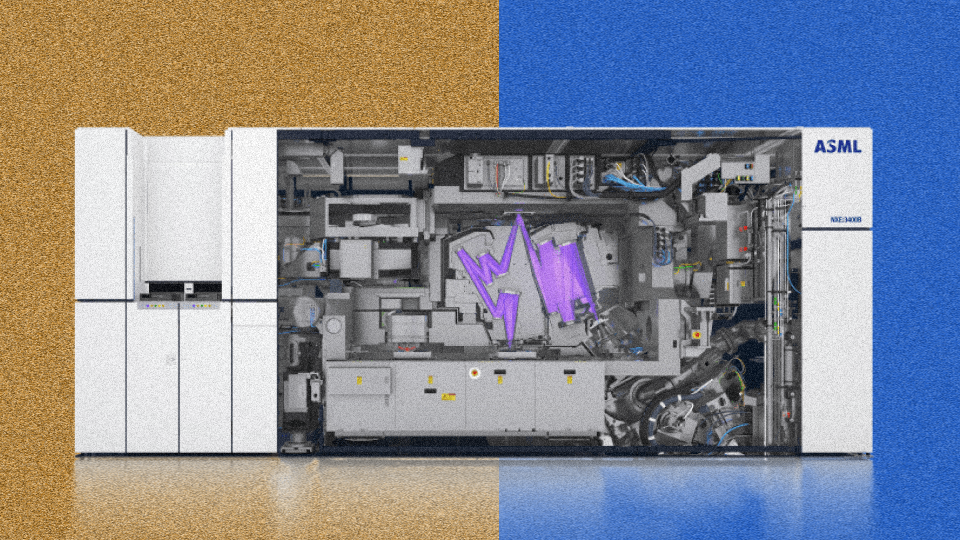
One of the most astonishing monopolies in the world is the ASML monopoly. It controls one hundred per cent of the entire global market for Extreme Ultraviolet Lithography.[1] Without an ASML machine, there are no leading-edge chips. Without leading-edge chips, there are no modern smartphones, no AI accelerators, no advanced military hardware. ASML has no rivals.
Now, because they are such a critical chokehold on the world’s economy, one should expect them to be highly profitable. At least they should have pretty impressive revenue numbers.
Depending on your expectations, they do have impressive revenue numbers. They made a little over €32 billion in 2025.[1] The EUV machines specifically, where they have their absolute monopoly, generated around €11.6 billion.[2]
Now let’s assume that Nigeria had built this, and we owned it. All of ASML, and we added all of that revenue to our gross domestic product. By the time you distributed the revenue across 220 million people, you’d get about $177 per head. In GDP per capita terms, that’s a pittance. For example, the Naira would only have to depreciate about 11% to wipe out all the gains. That could happen in a single weekend.
The most strategically powerful chokepoint in modern technology would, spread across a single large nation, be a rounding error. Nigeria could spend decades developing the technology, and it would only go from lower middle income to lower middle income.
So where is the money? If developing the most advanced piece of manufacturing technology in the world barely moves the needle for a large but poor country, what can?
I spent much of my early days in political commentary showing that exporting minerals and other resources was not good enough to make Africa rich, and that this was the case even if we captured more of the value of what was being exported.
That remains true, but my framing back then gives the impression that minerals are uniquely unworthy. That’s not correct, and that’s why I started this piece with ASML. It’s not about whether something is a raw material or, as we’ve seen, the most impressive piece of engineering the world has ever seen.
The intuition causing the misapprehension is the idea that if a lot of people can’t do without something, and you can offer that thing, then you become rich. However, that’s actually false at the national level. Nations are not like people; controlling a chokepoint does not automatically grant them wealth.
Indispensability and wealth capture are orthogonal. One does not necessarily produce the other, and conflating them is the issue.
Here is a new idea:
National wealth from any sector is roughly the product of two things: throughput, that is, the total volume of transactions flowing through the sector, and extractable margin, that is, how much of each transaction you actually get to keep after costs, competition, and substitution have done their work.
Wealth ≈ throughput × extractable margin
Indispensability does not appear anywhere in that formula. A country can be the sole supplier of something the world depends on and still score terribly on both terms simultaneously: tiny throughput because the world uses very little of it by volume, and/or thin margin because the marginal unit isn’t worth much (we’ll get into that later).
What the world cannot do without, and what the world will pay you, are entirely different questions.
This is the hypothesis. Let’s explore it.
Economics enjoyers will be familiar with the classic diamond-water paradox, which embodies the confusion over why prices don’t seem to track usefulness.
Water is so incredibly useful to life, the saying goes, yet it costs pennies. Literally dirt cheap in most places. While the diamond, a shiny rock that doesn’t do anything much besides being a shiny rock, is worth millions more.
Well, here’s a new paradox for you. How is it that diamonds are worth literally millions of dollars per kg, water is worth cents per kg, and yet, the entire market cap for diamonds is 10x smaller than the market cap for traded water?
Indeed, suppose you could own one of them entirely; one hundred per cent of the global diamond market, or one hundred per cent of the global water trade. Which would you take?
I’d take water and so should you.
Not because water is more valuable per unit. It isn’t, but when it comes to national wealth, that doesn’t matter.
Split it into two pieces.
Wealth isn’t just the margin on what you sell. It’s the area between that margin and the throughput.
Margin first. Per kilogram, diamonds obliterate water. We’re talking something in the range of a million to one. On this axis, diamonds win so completely that the comparison feels absurd, and this is the axis the instinct goes to first, which is exactly what leads us astray.
Throughput second. How much of each thing does the world actually buy? Here, water inverts everything. The global gem diamond market — rough stones, polished gems, jewellery — sits somewhere between $90 and $110 billion.[3] The traded water market, just the commercial skim and not the agricultural water priced near zero, runs from around $500 billion to nearly $1 trillion depending on definition.[4] Water beats diamonds on total market size ten times.
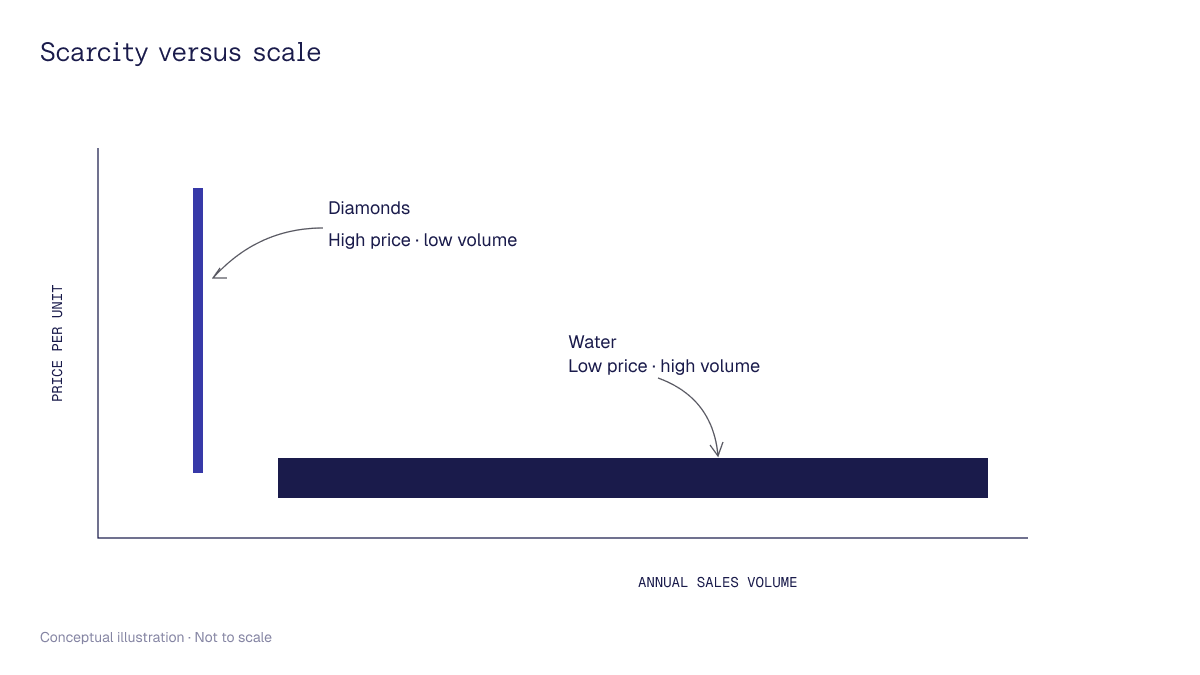
On the margin axis, diamonds win by a million to one. On the throughput axis, water wins by enough to cancel it entirely and gain a 10x lead.
A 10x difference is roughly the same difference between a country like, say, Angola, and Switzerland.[5]
Picture two rectangles. Height is extractable margin. Width is throughput. Diamonds are tall and thin: extraordinary height, almost no width. Water is short and wide: minimal height, enormous width. The area of each rectangle is the total wealth you’d capture by owning the whole market.
It’s not a mistake, nor is it a coincidence that things that are high value per unit tend to have small throughput; neither is it a global conspiracy. There are at least two structural forces that compress the market size of critical or highly valuable goods.
Many of us tend to overlook what prices actually are. They convey actual information. A high price basically tells people to NOT buy what you’re selling. It’s a flashing beacon plus a standing reward for your own demand destruction.
This tends to materialise in two different ways, depending on what kind of input you are.
Resources:
Expensive resources get used less. Simple.
Take Jevons Paradox, which basically captures how when a product becomes cheap, people tend to buy way more of it. This also happens in the opposite direction.
When things are expensive, people buy way less of them and structure their lives in such a way that minimises their use or replaces them with cheaper materials.
An example of this is silver in photovoltaic solar panels. Silver demand from PV fell 6% in 2025 and is forecast to drop 19% in 2026, even as solar installation keeps growing.[6] On a per watt basis, lab records have gone as far as 1.4mg/W even as mainstream cells have 5mg/W.[7]
So, silver use is not rising with the PV market. If your country was a silver supplier to some other country that made PVs, they could be getting richer every day, while you are not.
An even more dramatic example is cobalt.
There is a country that has a near monopoly on cobalt, the DRC, and they’re still a poor nation, but more importantly, every generation of Li-ion cells is attempting to drive down how much cobalt they’re using per kWh of storage. Early chemistries were one third cobalt, the latest chemistries have less than 10%.[8] Additionally, breakthroughs in battery technology are rapidly substituting the entire technology by using LFPs and sodium chemistries, which have no cobalt at all, for stationary storage and EVs, which are the two biggest applications. Cobalt prices have now collapsed from demand destruction.[9]
Rare earth metals are another interesting example here. They are used incredibly sparingly. A typical phone has only a few cents' worth of rare earth materials inside it and that number is driven down virtually every year.[10] Despite this, electronics companies are recycling them. For example, Apple now uses 100% recycled rare earth elements in all its magnets and is building a dedicated recycling facility rather than buying new supply.[11] At the moment, the entire market for rare earths is only about $4.1B.[12]
Capital:
The cost of a piece of equipment, i.e., capital, is amortised over the total goods that it can produce in its lifespan; also, capital tends to be lumpy. You can’t just subdivide a machine so you can use a smaller portion of it.
So what you do instead is make sure it works for the money. Let’s take ASML again. They made 11B from their EUV technology, but they only made that across 48 machines. That’s right. They sold fewer than 50 machines in an entire year.
This might seem surprising until you figure out that a single machine processes around 220 wafers an hour; each a 300mm disc that can hold hundreds of chip dies, running continuously to justify its $200M price tag.[13]
EUV is essentially economically untenable below a certain yield, which is partly why ASML has such a firm monopoly.
This pattern is pretty common. Large container ships are another example. Each one is expensive, but it carries tens of thousands of containers per trip. Below a certain throughput it becomes uneconomical so it just doesn’t get made. Same goes for power plants, data centres, etc.
If it’s expensive, it just never gets built unless the cost can be amortised over a massive amount of goods and services, which caps the market size.
In both cases the arrow goes the same way. High price -> frugal utilisation -> demand destruction -> capped market.
At the anarchic level of global geopolitics, a narrowly controlled critical element reads as a threat.
Indispensability is less a moat and more a target painted on your back.
China doesn’t exactly think ASML is amazing for coming up with EUV. They’re not saying “shut up and take my money”, they’re saying “That’s dangerous and we can’t let it continue.”
The US feels the same way about China and rare earth minerals.
So instead of shelling out as much money as they can for as much of the product as you have, they stockpile, find alternative sources, find ways to design you out, impose import controls, etc.
It’s important that they’re not doing this because it’s too expensive. The US for example can trivially buy the entire annual production of rare earth magnets that China makes, given that China’s total rare earth magnet exports in 2024 were worth $2.9 billion, less than 0.3% of the US defence budget.[14] They’re doing it because it’s critical and narrow.
Indispensability is less a moat and more a target painted on your back as other states gain a vested interest in destroying your market share for geopolitical purposes.
The biggest advantage of having critical goods and/or services is not that they will make you rich, but that you can cut them off and use them as leverage against the world.
Iran and the Strait of Hormuz come to mind here. They’ll never get rich off of taxing that strait. Others will simply build pipelines that bypass it if they charge too much, or other oil producers ramp up their production... but it’s extremely useful as leverage against the world.
This is also how China is using rare earths. China doesn’t need them to get rich — the entire global rare earth market is $4.1B, less than 0.2% of Guangdong province’s GDP alone.[15] However, they can use it as leverage against the US.
Countries that are actually trying to get rich and succeeding aren’t accumulating expensive, rare technology or digging out critical minerals. Most of the time they’re making pretty basic things that everyone uses at absurdly cheap prices.
And that’s exactly the point.
Because wealth is the product of throughput and margin, countries can ride a cheap, thin margin product out of poverty if the throughput is high enough. Things like garments, toys, plates, radios, ubiquitous, cheap, abundant, are the kinds of things that come up again and again in economic miracles. Now you hopefully know why.
This is only the beginning of a journey into how nations accumulate wealth. For example, while it’s true that wealth is a function of margin and throughput, this is only accurate as a snapshot. After all, markets grow and shrink and change.
You can’t just google the market cap of an industry, get the margins, and then plan the next 30 years of your country’s economic trajectory on the product.
There is also the problem of country size. You could imagine that if Nigeria had only 2 million people, ASML would grant us almost 18k USD in additional economic activity, which would be a massive windfall.
We need to think more holistically, as well as more dynamically, about wealth. In the next article, we will begin to do just this.
[1] Quantumrun, “ASML Statistics”. https://www.quantumrun.com/consulting/asml-statistics/
[2] ASML, “Q4 2025 Financial Results”. https://www.asml.com/en/news/press-releases/2026/q4-2025-financial-results
[3] Business Research Insights, “Diamond Jewelry Market Size & Forecast”. https://www.businessresearchinsights.com/market-reports/diamond-jewelry-market-110815
[4] Dataintelo, “Water Market Research Report 2034”. https://dataintelo.com/report/water-industry
[5] Our World in Data, “GDP per Capita — Angola vs. Switzerland”. https://ourworldindata.org/grapher/gdp-per-capita-maddison-project-database?tab=line&time=1955..latest&country=AGO~CHE&mapSelect=AGO~CHE
[6] PV Magazine, “Silver demand from PV industry expected to drop 19% this year”, April 2026. https://www.pv-magazine.com/2026/04/15/silver-demand-from-pv-industry-expected-to-drop-19-this-year/
[7] Fraunhofer ISE, “Silicon Heterojunction Solar Cells Realized with Record Savings in Silver”, 2025. https://www.ise.fraunhofer.de/en/press-media/news/2025/silicon-heterojunction-solar-cells-realized-with-record-savings-in-silver.html
[8] Adamas Intelligence, “Decrease in Cobalt Deployed in EVs by Sales-Weighted Average”. https://www.adamasintel.com/decrease-in-cobalt-deployed-in-evs-by-sales-weighted-average/
[9] IEA, “Global EV Outlook 2025 — Electric Vehicle Batteries”. https://www.iea.org/reports/global-ev-outlook-2025/electric-vehicle-batteries
[10] TechAcute, “Rare Earths and Metals in Your Smartphone”, 2025. https://techacute.com/rare-earths-and-metals-in-your-smartphone/
[11] Apple Newsroom, “Apple expands US supply chain with $500 million commitment”, July 2025. https://www.apple.com/newsroom/2025/07/apple-expands-us-supply-chain-with-500-million-usd-commitment/
[12] Fortune Business Insights, “Rare Earth Elements Market Size, Share & Global Report”. https://www.fortunebusinessinsights.com/rare-earth-elements-market-102943
[13] TechSpot, “ASML pushes EUV power to 1,000 watts, unlocking up to 50% more chips per machine”. https://www.techspot.com/news/111451-asml-pushes-euv-power-1000-watts-unlocking-up.html
[14] China Briefing, “China’s Rare Earth Elements: What Businesses Need to Know”. https://www.china-briefing.com/news/chinas-rare-earth-elements-dominance-in-global-supply-chains/
[15] GDToday, “Guangdong Province’s GDP is expected to reach 14 trillion yuan in 2024”. https://www.newsgd.com/node_d36b0ef83f/019f58c5a4.shtml