India is the world's sixth-largest economy and about 140th in income per person. Why large countries can be rich in aggregate but poor at the individual level, and what it takes to change that.

Favour Ayorinde
Favour Ayorinde
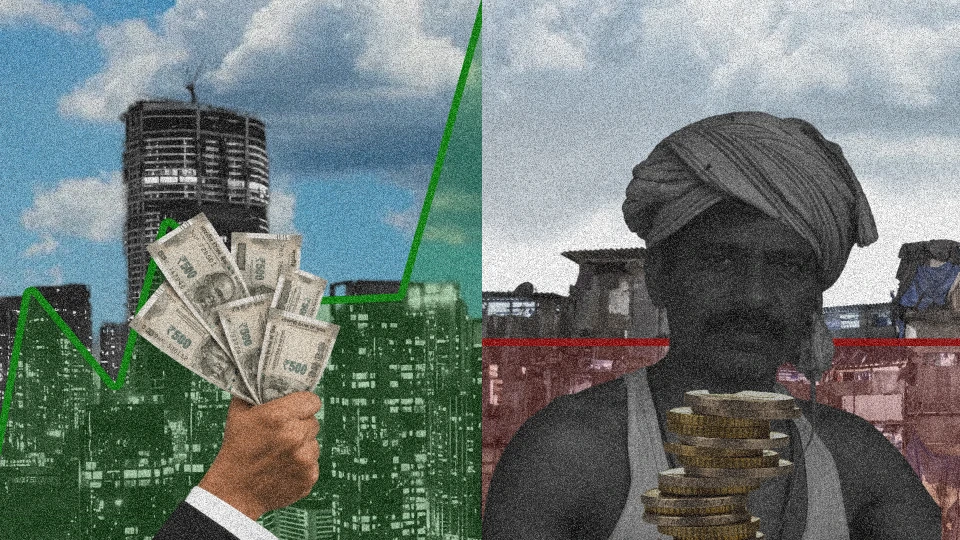
India is the sixth-largest economy in the world ($4.15T nominal), and the third-largest once you account for purchasing power parity.[1]
India is also 140th per capita.[2] The average Indian is poorer than the average person in most other countries, even though the country's economy is massive.
This is a population artefact, of course. India, despite being poorly productive on a per-person basis, is able to throw its weight around on the global stage because it is simply a gigantic country, 1.4 billion people and still rising.[3] With a population of over 50 million, India qualifies as a large country.
The question of whether India is rich has no single answer, in fact, because "rich" can mean three different things.
This is often captured in GDP. It is the total economic output the economy produces. This is where India shines.
This is what the state can extract from the population; call it tax revenue if you wish. Some countries are better at this than others.
This is what actually affects the life of the ordinary person living in the country. For India, this is poor.
In a small country, these values tend to move together. A poor small country often has a poor government, and a rich small country often has a rich government. In a large country, a government can become rich before the rest of the population, with some interesting implications.
Most countries have at least one tradable sector; these are the sectors that produce the goods that the country exports in exchange for earnings that it can use to import goods and services. Examples include agriculture, manufacturing, services and resource extraction.
We'll isolate two properties of a tradable sector: value capture and head-scalability.
Value capture is just the profits and the wages that the local economy captures from that sector. Head-scalability is just how easy it is to absorb new members of the economy into that sector and retain value capture rates.
Head-scalability is split into three main regimes.
Here the population does not set the size of the value capture at all. An example of this would be resource rents or chokepoints. Take, for example, Botswana's diamonds, which gave a country of 2.5 million people[4] significant wealth for a few decades.[5] If there had been 25 million Batswana instead, they wouldn't have earned ten times more money from diamonds; they would simply have been ten times poorer. The head-scalability is fixed.
Here the population weakly sets the size of the value capture because the skill required is high and only a small fraction of the population can participate at all. Examples would be elite services, software and finance.
A concrete example of this would be Nigeria's fintech ecosystem, which, while it has managed to absorb a great many upwardly mobile, brilliant young Nigerians, has no chance of absorbing even a tiny fraction of the tens of millions of poor farmers Nigeria currently has.[6, 7]
Here the population acts as a massive lever because a large, ordinary workforce can be almost immediately deployed into margin-earning roles. And so the capturable value rises almost monotonically with population size. Examples would be agro-processing and light and heavy manufacturing.
For large countries, sectors with fixed head-scalability are often mostly bad. The rent produced hits a hard cap, and most of the value is quickly gobbled up by a small and concentrated elite. The phenomenon at work here is simple:
Suppose that a large country finds itself subsisting on income from some rent, say through oil, mineral production, or through controlling a specific chokepoint. The rent must then be shared amongst the entire population, but the rent is usually small, often less than 5% of total GDP for very large countries, even after refining.[8]

On the one hand, each leader faces stiff competition from counter-elites, who are often quite numerous in large countries, so they have a strong incentive to stockpile resources and spend on defending themselves.
On the other hand, the electorate is so large that it cannot realistically notice whether the rents being earned are spent rationally.
Under these conditions, the rational action that the elites have is to corner as much of that rent as possible and distribute it within a small, tight network of patronage, while investing in highly visible infrastructure projects that are easy to show off as "fruits" of the national income, but which are then promptly abandoned because maintenance is invisible.
Skill-bounded scalability struggles to increase living standards broadly. This can lead to immiserating growth, where small, rapidly modernising enclaves drag up aggregate production while everyone else gets poorer.
Skill-bounded incomes are shared in two main ways. First, through taxation, where the small group that is providing global services is taxed, and their income is spent by the government on the rest of the people. Second, through cost disease, where wages in the skill-bounded sector are so attractive that people want to move into those fields, which then drives up wages in other sectors.[9]
In a large country, both mechanisms are weakened. First, because the taxed rents must be shared amongst a large population, the people being taxed almost never see a return on their taxes. From their perspective, their money is harvested and poured into a bottomless hole.
This leads to tax avoidance, if not evasion.
Second, because the population is very large, the skill-bounded sector can continually absorb new labour for generations without bidding up wages elsewhere. This is because of the slow nature of this absorption.
Consider programming: in order to be good enough to be world-class, you usually need to first have years of regular education, often an actual degree, then you need a few years of programming experience. In a large country, this puts you in a small group that slowly expands outward. The poor farmer in the village may never become a programmer; his child might not either; perhaps only his grandchild will.
The long delay between when a policy of integration starts and when that integration actually happens can be years, if not decades, and that forces a slow diffusion that shows up as slow economic growth.
To be clear, what this means is that, unlike fixed scalability, large countries engaging in skill-bounded scalability WILL likely get wealthy eventually; they will simply have to crawl their way up through multiple generations.
Mass scalability allows you to take the hypothetical rural farmer we mentioned and put him in a factory today, and get him up to speed in less than 3 months. Within a short period of time, you can triple his productivity by moving him from a low-productivity sector like agriculture to a high-productivity sector like agro-processing or manufacturing.
And you can do this for people in the millions. This is mostly why Asian countries grew so rapidly.

Also, large countries have an extra cheat code. Even a small bump in worker productivity leads to massive surpluses at the core; more on this later.
But if it's this great, why isn't every large country doing it?
The problem is that a large productive base needs a large consumer base. And the difference between the total wealth of the consumer base and the productive base matters.
A large economy can simply sell to itself; it can create an internal market and develop from there. This is what America did. It industrialised largely without exporting to wealthier countries, but America also grew slowly: only about 1.75% real growth per capita a year between 1870 and 1913.[10]
But if a large economy tries to find an outside buyer, it immediately runs into problems; its sheer size prevents it from riding economic waves without scrutiny.
China is the obvious example. Despite exporting only one in five of its cars,[11] it is threatening to destroy the car industries in many European countries due to sheer scale.

So for large countries, economic progress is geopolitical success. Their economic actions happen at such a large scale that they directly affect other nations.
A large population, at even modest taxation rates, generates massive surpluses for governments. This allows large countries to achieve geopolitical weight without high worker productivity. A small country has to be extremely wealthy in order to become a great power or even a regional power; a large country gets this nearly effortlessly.
An example of this is India, which, despite being slightly poorer than Kenya per capita,[12] has a space programme,[13] a massive modern military,[14] and a massive steel industry, the second largest in the world.[15]
China is an even more dramatic example. By all accounts, China is only a middle-income economy; it is on par with many Latin American countries on a per capita basis.[16] However, in aggregate, it is the only serious rival to the US[17] and is the factory of the world.[18]
This can produce a country that is "rich" in aggregate but "poor" on the individual level.

Large countries suffer from any source of income that is not directly based on their population, because the money must then be shared amongst a large base, which leads to problems. Large countries succeed to the extent that they are able to derive income from sectors that mobilise their labour directly and quickly.
However, large countries that mobilise labour directly and quickly have strong, unmistakable effects on the global economy; thus, for them, economic development is very strongly dependent on geopolitics. Large countries that are unable to secure buyers for mass-manufactured products remain relegated to fixed rent pools or skill-bounded sectors that convert poorly.
Most large developing countries are in this position today, and from an economic standpoint, nothing much will change until they can learn to leverage their population, turning them from expenses into assets.
[1] Ease My Prep, "India no longer the fourth largest economy: IMF data shows Japan and UK ahead" (IMF WEO April 2026), https://easemyprep.in/news/719-india-no-longer-the-fourth-largest-economy-imf-data-shows-japan-and-uk-ahead-but
[2] Anantam IAS, "India GDP Rank" (from IMF data), https://www.anantamias.com/india-gdp-rank/. See also: https://statisticsoftheworld.com/country/india/gdp-per-capita
[3] UN DESA, World Population Prospects 2024, via Onmanorama, "India's population to peak in 2060s, to remain world's most populous through 2100: UN," https://www.onmanorama.com/news/world/2024/07/12/india-remain-most-populous-country-world-throughout-century-states-un-report.amp.html
[4] World Bank, "Population, Total for Botswana," via FRED, https://fred.stlouisfed.org/series/POPTOTBWA647NWDB
[5] NY1 / AP, "Botswana, the country with the biggest diamonds, gets an improved 10-year deal with miner De Beers" (Feb 2025), https://ny1.com/nyc/all-boroughs/ap-top-news/2025/02/26/botswana-the-country-with-the-biggest-diamonds-gets-an-improved-10-year-deal-with-miner-de-beers
[6] Connecting Africa, "Nigeria leads African tech startup funding, fintech dominates," https://www.connectingafrica.com/startups/nigeria-leads-african-tech-startup-funding-fintech-dominates
[7] TheGlobalEconomy, "Nigeria: Employment in agriculture," https://www.theglobaleconomy.com/Nigeria/Employment_in_agriculture/
[8] Politis, "Russian oil and gas revenues fall 24% to lowest level since 2020" (Russian Finance Ministry data), https://en.politis.com.cy/globe/980356/russian-oil-and-gas-revenues-fall-24-to-lowest-level-since-2020. See also: https://21stcenturychronicle.com/nigeria-failed-to-meet-oil-revenue-target-in-h1-2025-budget-office/
[9] William J. Baumol and William G. Bowen, Performing Arts: The Economic Dilemma (New York: Twentieth Century Fund, 1966). See also Baumol and Bowen, American Economic Review (1965), which introduced the concept.
[10] Maddison Project Database via Our World in Data, "GDP per capita," https://ourworldindata.org/grapher/gdp-per-capita-maddison-project-database
[11] CAAM figures via Car News China, "China forecasts auto exports above 6.8 million vehicles in 2025," https://carnewschina.com/2025/11/29/china-forecasts-auto-exports-above-6-8-million-vehicles-in-2025-industry-official-says/. See also: https://news.metal.com/newscontent/103720172-chinas-auto-production-and-sales-hit-record-high-for-17-consecutive-years-smm-special-report
[12] Statistics of the World, "Kenya GDP per capita" (IMF), https://statisticsoftheworld.com/country/kenya/gdp-per-capita
[13] Engadget, "India is the first country to land at the Moon's south pole" (Chandrayaan-3, 23 Aug 2023), https://www.engadget.com/india-is-the-first-country-to-land-at-the-moons-south-pole-133322596.html
[14] PIB, "Defence in Union Budget 2026-27," https://static.pib.gov.in/WriteReadData/specificdocs/documents/2026/feb/doc202623778301.pdf
[15] Ministry of Steel, Government of India, "Annual Report 2025-26," https://steel.gov.in/sites/default/files/2026-04/Final%20Annual%20Report%202025-26%20%28English%20Version%29.pdf
[16] CEIC, "China GDP per Capita," https://www.ceicdata.com/en/indicator/china/gdp-per-capita. See also: https://georank.org/facts/argentina/china
[17] StatisticsTimes, "United States vs China economy," https://www.statisticstimes.com/m/economy/united-states-vs-china-economy.php
[18] World Bank data via Cargoson, "How big is the manufacturing industry," https://www.cargoson.com/en/blog/how-big-is-the-manufacturing-industry. See also: https://robeco.substack.com/p/workshop-of-the-world